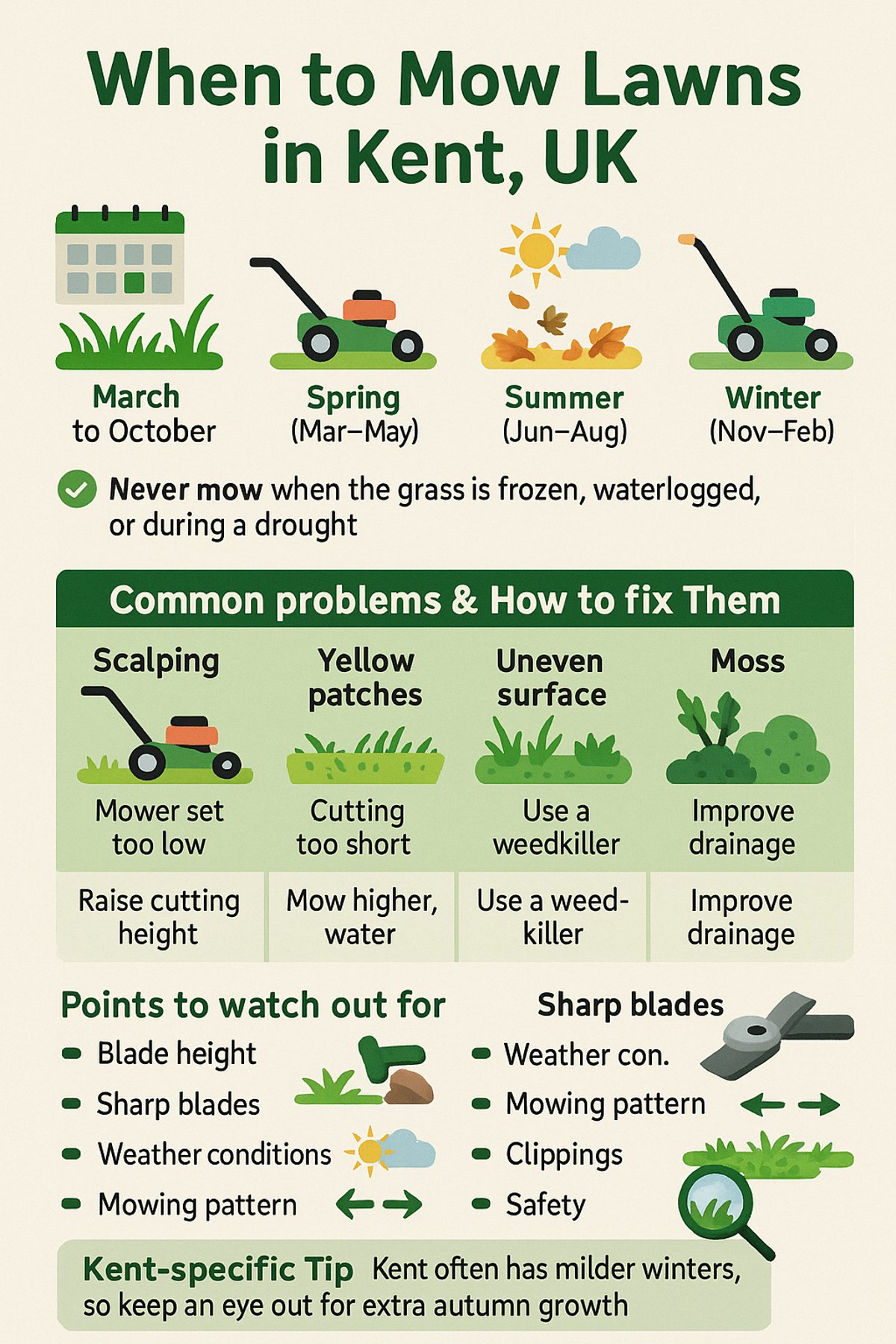
Kent has a drier climate than most of England, with more sunshine hours and less summer rainfall than the national average. That means lawns in Sandwich, Deal and the surrounding villages go into drought stress faster than gardens further north, and the dry spells we have been experiencing since May 2026 have turned a lot of previously green lawns the colour of old straw.
The good news is that a lawn that has gone brown in a dry spell is very often dormant, not dead. Grass is more resilient than it looks. Robbie Lynn at Premier Lawns, who runs the UK's largest lawn care YouTube channel (100,000 subscribers) and has 30 years of professional experience, explains this well in a recent video: How To Bring Your Brown Lawn Back To Life After UK Heatwave! (Premier Lawns, YouTube). The key point is that you need to know whether you are looking at dormancy or actual death before you decide what to do next.
Before you start: what not to do
- Do not apply fertiliser, weedkiller or moss treatments to a stressed, brown lawn: it cannot use them and some will cause further damage.
- Do not scarify, aerate or use a lawn rake while the ground is bone dry.
- Do not cut the grass shorter than usual: longer grass shades the soil and helps hold moisture.
- Do not assume the lawn is dead and re-turf it until you have waited at least three weeks after consistent rain has returned.
Step 1: Is the grass dormant or dead?
This is the first and most important question. Dormant grass looks dead but the crown (the growing point at soil level) and the root system are still alive. Dead grass has lost both.
The screwdriver test: push a flat-head screwdriver about 10 cm into the soil. If it goes in without too much resistance and the roots you expose are pale or white (not brown, slimy or disintegrated), the plant is almost certainly dormant. Try this in several spots, including the worst-looking areas. If the soil is concrete-hard and nothing alive is coming up through it even three to four weeks after rain has returned, those patches may be genuinely dead and will need reseeding.
In clay-based soils, common around Ash, Woodnesborough and Eastry, the soil can set like brick in a dry summer. A spiking once the drought breaks helps water get in so dormant grass can recover. Sandy soils near Sandwich Bay drain more freely and tend to green up faster once rainfall returns.
Step 2: Stop making it worse
While the lawn is still brown and the weather is still dry and hot, the best thing you can do is leave it alone. Raise the blade height to at least 40 mm if you do need to cut it (because some sections are still growing), change direction regularly so you do not repeatedly stress the same sections, and use the lightest possible mower for the conditions.
Avoid mowing in the heat of the day. If you must cut during a heatwave, early morning is least damaging.
Step 3: Water if you can
If hosepipe restrictions allow, deep and infrequent watering is much more effective than daily light watering. Aim for at least 25 mm per session (place a jar in the garden when you water to measure it), twice a week. This encourages roots to grow deeper, where the soil retains moisture for longer.
Apply water early in the morning to reduce evaporation. Avoid watering in the evening if you can, as damp grass overnight encourages fungal problems. Lawns in the more exposed parts of Deal or along the Sandwich Bay seafront may dry out faster due to coastal winds and may benefit from slightly more frequent irrigation.
Step 4: Let rainfall do the recovery work
Once rain returns and temperatures drop, step back and watch. Most established Kent lawns begin showing green at the base of brown grass blades within five to ten days of meaningful rainfall. Within two to three weeks of consistent rain, a previously dormant lawn can look quite presentable without any intervention at all.
Resist mowing during the first week of recovery. Let the new growth get established before you cut it. When you do mow again, set the blade slightly higher than usual for the first two or three cuts, then gradually return to your normal height.
Step 5: Apply an autumn feed once growth has resumed
From mid-September onwards, once the lawn is visibly growing again and the weather is reliably below 25°C, apply an autumn lawn fertiliser. Autumn formulations have lower nitrogen and higher potassium and phosphorus than spring and summer products, which strengthens roots and builds resilience for winter rather than pushing soft top growth.
Do not use a spring/summer high-nitrogen feed at this point: it promotes growth the plant cannot sustain as daylight shortens and temperatures drop, and it makes the grass more susceptible to red thread and other fungal diseases heading into autumn. Our lawn feeding guide explains the seasonal differences in more detail.
Step 6: Overseed any patches that did not recover
Some patches may not green up with the rest of the lawn by mid-September. These are either genuinely dead (the crown did not survive) or very thin and slow to recover. Either way, overseeding in September is the right fix. The soil is still warm enough for seed germination but the cooler, wetter autumn conditions mean seedlings are much less likely to dry out before they establish.
Scratch the dead surface lightly with a rake, apply a good-quality grass seed at the recommended rate, rake lightly to cover, and water in. Our overseeding guide and bare patches guide both cover the detail.
Stop and call us if
- The lawn has not shown any sign of recovery two to three weeks after consistent rain: the grass may be dead across a large area and re-turfing or heavy overseeding is likely needed.
- More than half the lawn looks affected: a professional assessment will save you money and effort compared with guessing at patches.
- You are on a chalk or very free-draining soil and water is running off before it can penetrate: compaction relief work may be needed before the lawn can recover.
Prefer we take a look?
If you are not sure whether your lawn is dormant or done for, or the recovery is not going as well as you hoped, get in touch. We cover Sandwich, Deal, Worth, Ash, Woodnesborough, Eastry and Sandwich Bay and can give you a straight answer about what it needs.