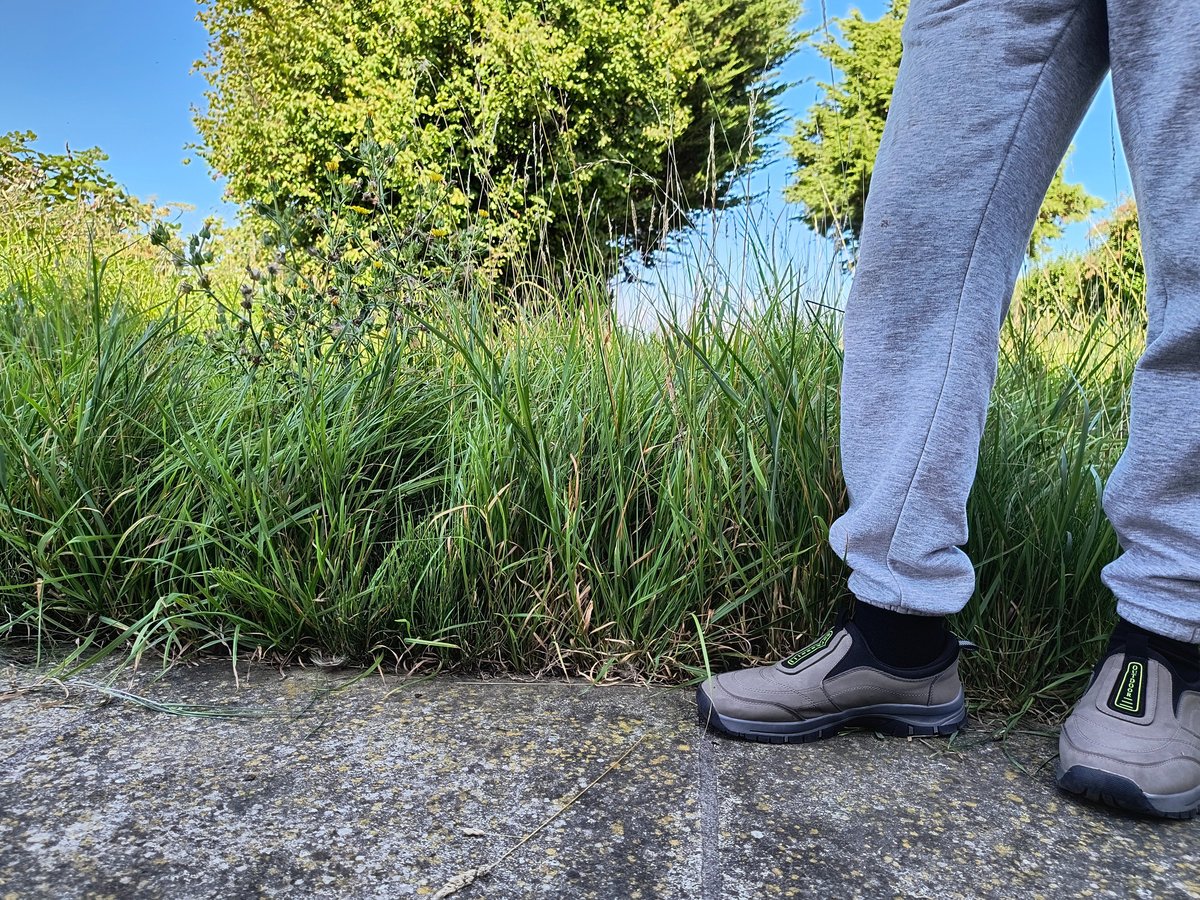
Broadleaf weeds are the flat-leaved plants that grow among the grass: dandelion, daisy, clover, plantain, buttercup and yarrow are the most common ones we see across gardens in Sandwich, Deal and the surrounding villages. They spread quickly in lawns that are mown irregularly, cut too short, or growing on thin or nutrient-poor soil.
Pulling them out by hand works well for a few isolated plants in borders and beds. For weeds spread across lawn turf, a selective lawn weedkiller is the practical solution: it targets broadleaf plants specifically and leaves the grass unharmed when used correctly.
This guide is about chemical weed control on lawn turf. If you are looking for advice on removing weeds from borders and beds by hand, see our separate guide on removing weeds without chemicals.
Before you start: safety and preparation
- Read the product label in full before opening the bottle. Application rates, re-entry times and storage instructions vary between products.
- Wear gloves when handling concentrated liquid products and wash hands thoroughly afterwards.
- Keep children and pets off the treated area until the product has dried, or for the time stated on the label, whichever is longer.
- Avoid spraying on a windy day. Coastal wind near Sandwich Bay, Deal seafront and Sandwich town can carry fine spray onto neighbouring beds, ponds or over garden boundaries.
- Do not apply before forecast rain. Rain within 24 hours washes the product off before it is absorbed, wasting the treatment.
Step 1. Identify the weeds in your lawn
Most selective lawn weedkillers target a broad range of common broadleaf weeds in a single application, but knowing what you have helps you choose the right product and set realistic expectations.
- Dandelion: large tap root, rosette of jagged leaves, yellow flowers. Established plants with deep roots may need two applications.
- Daisy: low-growing rosettes with white flowers. Usually responds well to a single treatment.
- White clover: three-part leaves, spreads along the ground. Can be resistant to some formulations; look for a product that lists clover specifically.
- Plantain (broad-leaf and ribwort): oval or lance-shaped leaves, ribbed. Both types are well controlled by most standard selective weedkillers.
- Creeping buttercup: low-growing, yellow flowers, spreads by runners. More common on damp, heavy soils such as those in Ash and Eastry.
- Yarrow: feathery leaves, white flowers, can be stubborn and may need repeat treatment.
Step 2. Choose the right selective weedkiller
Selective lawn weedkillers work by targeting the growth hormones in broadleaf plants. Common active ingredients on UK product labels include MCPA, mecoprop-P, dicamba and fluroxypyr. These are safe for grass at the labelled rate but will damage ornamental broadleaf plants if sprayed on them.
Available formats:
- Ready-to-use trigger spray: easiest for spot-treating a few weeds or small patches. No mixing, no equipment to clean.
- Concentrated liquid: more economical for larger areas. Mix to the label rate and apply with a garden sprayer dedicated to weedkiller only.
- Lawn weed-and-feed granules: combines fertiliser with selective weedkiller. Applied with a spreader and watered in. Good for general renovation but less targeted than a spray for patchy weed distribution.
For most East Kent gardens with weeds scattered across the lawn rather than covering the whole surface, a ready-to-use or dilutable liquid gives the most precise application.
Step 3. Pick the right weather window
The conditions when you apply matter as much as the product itself. Apply when:
- The grass is actively growing and the soil is not bone dry
- Daytime temperature is between 10°C and 25°C
- No rain is forecast for at least 24 hours after application
- There is little or no wind, particularly important in coastal areas near Sandwich Bay and Deal
The best windows in Kent are late April to June and early September, when the grass is growing strongly and weeds are actively taking up nutrients through their leaves. Avoid applying in drought or during the hottest weeks of summer when the grass is already under stress from heat and dry conditions.
Step 4. Apply the product safely and evenly
Do not mow for two to three days before applying, to give the weeds maximum leaf surface area to absorb the product. Then apply the weedkiller evenly across the affected area:
- Use a fine spray setting, not a jet; you want a gentle coverage, not a drench
- For concentrated products, mix to the exact label rate; stronger is not more effective and risks grass damage
- Apply in one direction, then if needed cross again at 90 degrees for even coverage on larger areas
- Avoid spraying near ponds, vegetable beds or ornamental plants; selective weedkillers damage most broadleaf ornamentals and are toxic to aquatic life
- Keep the sprayer tip low to reduce drift, especially on windy days
After applying, do not mow for at least two to three days to allow the product to be fully translocated from the leaves down to the roots.
Step 5. Wait, assess and repeat if needed
Selective weedkillers work slowly. You will see the weeds beginning to yellow, distort and die back over two to four weeks. Do not be concerned if nothing seems to happen in the first week; that is normal.
After four weeks, assess what remains:
- Most weeds gone: overseed any bare patches left behind to prevent recolonisation
- Some weeds persisting: apply a second treatment four to six weeks after the first
- Clover or yarrow still present: these may need a third application or a specialist product formulated for resistant species
Bare patches left by dead weeds will fill in naturally over time in a dense lawn, but reseeding them promptly gives the grass a head start over returning weeds and moss.
Video reference: How to kill weeds in your lawn by Garden Lawncare Guy, a UK lawn care channel with millions of views, covering the practical approach to removing clover, daisy and dandelion from lawn turf using selective weedkiller.
When to stop and call us
If weeds cover more than about a third of your lawn surface, weedkiller alone is rarely the most cost-effective solution. A lawn that is that heavily infested often has an underlying problem: thin grass, low fertility, compaction or poor drainage that is allowing weeds to establish. We can have a look, advise on whether a full renovation makes more sense than repeated treatments, and carry out any work needed. We cover Sandwich, Deal, Worth, Ash, Woodnesborough, Eastry and Sandwich Bay. Get in touch for a free quote.