Spring is the season when a year's worth of lawn success or struggle gets decided. Do the basics in the right order and the grass goes into summer strong. Skip them and you spend the rest of the year chasing problems.
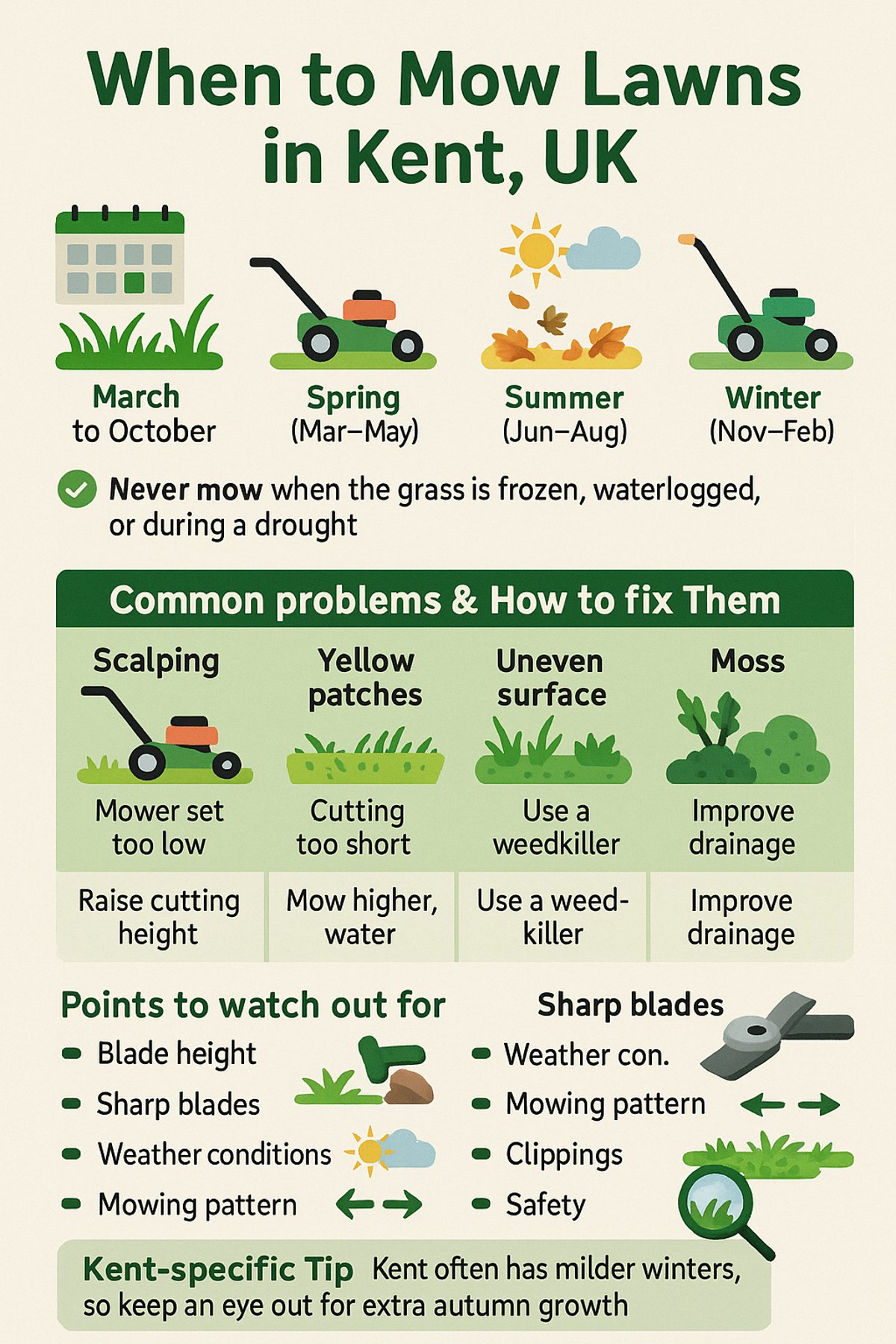
Because Kent has milder winters than most of the UK, the grass here starts growing earlier, sometimes as early as the first week of March in gardens near Sandwich Bay or along the Deal coast. That is a bonus, but it also means you need to be ready a few weeks before gardeners further north.
Before you start: safety
- Wear sturdy closed footwear whenever you walk a lawn with a powered mower nearby.
- Check the whole lawn for stones, toys, pet mess and debris before you mow, a mower blade at speed can throw a stone a long way.
- Wear ear defenders with petrol machinery. Cordless and electric mowers are significantly quieter.
- Disconnect the battery or unplug before clearing a blockage or changing a blade. Never use your hands to pull out jammed material with power still connected.
- Keep children and pets off the lawn while the mower or strimmer is running.
- If you are using a petrol machine for the first time this season, check the oil level and make sure the air filter is clean before you start.
Step 1 · Check conditions before you do anything
Spring care done at the wrong time does more harm than good. The golden test: if you step on the lawn and leave a clear, soggy print, the soil is too wet and you should wait. Mowing or working on waterlogged ground compacts the soil and damages grass roots. Aim for:
- Soil temperature consistently above 5°C (the grass is not growing below this).
- No frost overnight or forecast.
- Ground firm enough that you are not sinking or leaving deep prints.
In a typical Kent spring this moment arrives in the last week of March, give or take. In gardens with clay soil, which is common in parts of Ash, Woodnesborough and Eastry, the ground holds water longer so you may need to wait a week or two more than your neighbours.
Step 2 · Walk and clear the lawn
Long grass and last year's leaf fall hide all sorts. Walk every part of the lawn before the first mow and pick up stones, fallen branches, seed pods, garden canes left over from winter, dog toys and anything else that should not be there. This protects your mower blades and prevents objects being thrown at speed across the garden.
Step 3 · The first mow: high blade, gentle pass
Set the mower on its highest cutting height, usually 6 to 8 cm. The aim is to take the tops off the grass, nothing more. Do not be tempted to drop the blade and "get it done" in one go. Cutting more than a third of the blade height at once stresses the plant and can cause yellowing or even kill patches that are already weak from winter.
- Mow when the grass is dry, wet grass clumps and drags on the blade.
- If the grass is very long from a mild winter, you may need to do two passes a few days apart before dropping the blade.
- Collect the first clippings rather than leaving them, they tend to be wet and will mat down on the grass.
Step 4 · Rake out winter debris
A spring-tine rake (the fan-shaped one with many fine tines) lifts dead material from the base of the grass without pulling out healthy growth. Work methodically across the lawn in one direction, then again at 90 degrees. You are looking to clear:
- Dead leaf fragments and moss that crept in over winter.
- Matted thatch, the spongy brown layer that builds up between the green grass and the soil surface.
- General debris from the winter months.
Do this before feeding, so the fertiliser can actually reach the soil and root zone rather than sitting on top of a mat of dead material.
Step 5 · Aerate compacted patches
If any part of your lawn felt spongy and waterlogged all winter, or if puddles sat there for hours after rain, it is worth aerating those patches now. Push a garden fork to around 15 cm depth, lever it gently to open up the channels, pull it out and move forward 10 cm. Repeat across the area.
Heavy clay soil, which you find in parts of East Kent, compacts easily under foot traffic and rain. Aeration opens the soil up, improves drainage and lets air down to the roots before summer.
Step 6 · Apply a spring feed
From April onwards, when the grass is growing well, apply a spring or general-purpose lawn fertiliser. These formulations are high in nitrogen, which encourages the leafy growth you want through the growing season. Read the label carefully and apply at the recommended rate. More is not better: over-feeding scorches the grass and wastes money.
- Apply when rain is forecast but the lawn surface is dry, this helps the fertiliser wash into the soil without runoff.
- Avoid feeding in a cold snap. Fertiliser works best when the grass is actively growing.
- Keep children and pets off the lawn until any granular feed has been watered in or until a liquid feed has dried.
Step 7 · Overseed bare or thin patches
Late April to mid-May is a good window for overseeding in Kent. The soil has usually warmed to around 10°C by then, which is the minimum for reliable germination. Autumn is slightly better for germination rates (warm soil plus reliable rain), but spring works well if you can water the seed in during dry spells.
- Scratch the surface of the bare patch with a rake or hoe to create a fine, crumbly surface for the seed.
- Sow seed at the rate shown on the packet. Use a grass seed mix suited to UK conditions.
- Rake lightly to cover the seed with a thin layer of soil.
- Firm it down with the back of the rake or your foot.
- Water gently and keep the patch moist for the first two to three weeks.
Protect newly seeded areas from birds if you can. A small amount of net or some cane-and-twine will do.
Step 8 · Strim and edge to finish
The last job of the spring clean-up is the one that transforms a lawn from "mowed" to "looked after." Run the strimmer along the bases of walls, fences and beds, then use a strimmer or half-moon edger to redefine the lawn edge where it meets paths and borders. A clean, sharp edge costs ten minutes but makes a real difference to how the whole garden looks.
Stop and call us if:
- The ground is waterlogged and is not draining, powered equipment on saturated ground makes compaction significantly worse.
- You are on a steep bank that would require you to work with a petrol mower sideways on a slope.
- The grass is extremely long (knee height or above) from a full winter of neglect, a phased professional rescue is safer than trying to cut it all at once with a domestic mower.
- You need petrol equipment but have not used it before or have not been trained on it.
We cover Sandwich, Deal, Worth, Ash, Woodnesborough, Eastry and Sandwich Bay. Get in touch and we will take it from there.
A note from Garden Lawncare Guy
Garden Lawncare Guy is a UK-based lawn seed and feed business whose YouTube channel has helped millions of British gardeners get better results at home. Their video April Tips For A Perfect Spring Lawn is a solid walkthrough of the April jobs in particular, including feeding and overseeding bare patches.
Prefer we just get on with it?
We do spring clean-ups across Sandwich, Deal, Worth, Ash, Woodnesborough, Eastry and Sandwich Bay. First mow, rake, edge, feed if you want it: the works. Book us in and we will pop round.