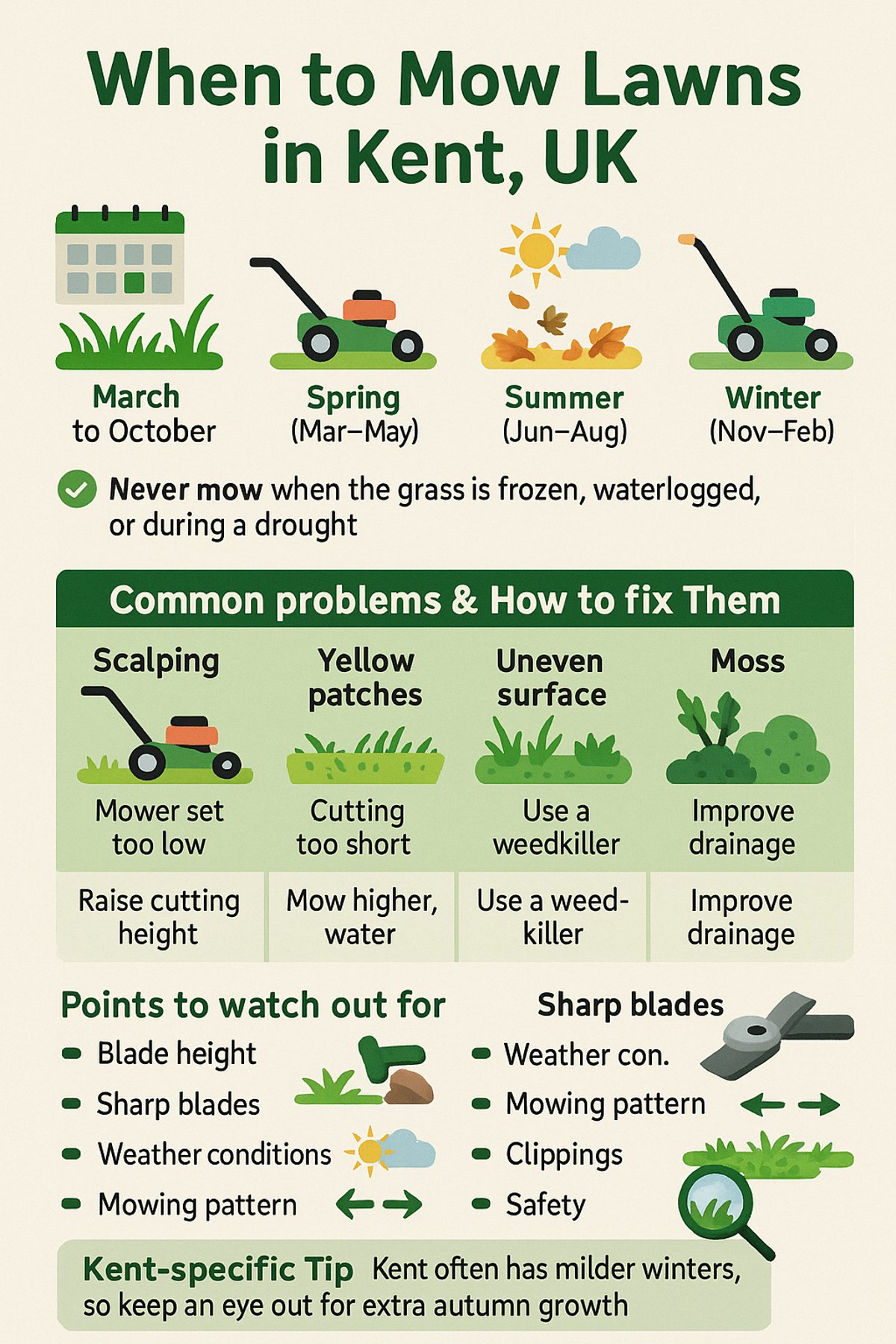
The general advice you see online about winter lawn care is written for the UK as a whole, which means it often tells you to stop doing everything in October and not start again until April. In East Kent, that is usually too cautious. The growing season here runs two to four weeks longer than in the north, frosts are lighter and less frequent, and a mild December can mean the grass is still doing something.
That said, there are still things you genuinely should not do in winter, and a few things that will make a real difference to how the lawn looks in spring if you get them right now.
Quick checklist: winter lawn tasks by month
- November: final mow if conditions allow, clear leaves weekly, spike waterlogged patches
- December: keep leaves clear, stay off frosted grass, no mowing or feeding
- January: mostly leave it alone, spike wet areas if firm enough
- February: still no mowing or feeding, walk the lawn and note what needs doing in spring
November: the wind-down month
November is usually the last month where you can still usefully do things to the lawn. The grass is slowing down but often still growing, especially after a mild October.
Final mow: aim for mid-November if conditions allow. Set the blade higher than summer, around 3.5 to 4 cm. The grass going into winter slightly longer holds moisture better and copes with frost more easily than one cut short. Always mow on a dry surface and avoid cutting in the evening when dew is already settling.
Leaf clearance: this is arguably the most important November job. A solid layer of fallen leaves left on the lawn blocks light and air, traps damp against the grass surface and creates perfect conditions for moss, fungal disease and general decline through the dark months. Rake or blow leaves off the lawn every week through November rather than leaving one big clearance for December.
Spiking wet patches: if parts of the lawn are slow to drain after rain, push a garden fork in while the soil is still firm enough to work without smearing. This helps water find channels down before the really wet weather arrives.
When to stop mowing in winter
There are three conditions that must all be true before mowing in winter is worth doing:
- The grass is actually long enough to need it, not just tidying for the sake of it
- The surface is dry, and the soil underneath is firm, not soft or waterlogged
- The temperature is above 5 degrees Celsius, the point at which grass growth essentially stops
If all three are ticked, a very light trim, on the highest setting, will do no harm and may make the lawn look neater through winter. In a warm December in Sandwich or Sandwich Bay, a final cut before Christmas is quite common. In a cold, wet December, leave it alone entirely.
December to February: mostly leave it alone
The middle of winter is not a time to be treating the lawn. In particular:
- No feeding: fertiliser applied to a lawn that is barely growing just sits in the soil and washes away in rain. Worse, a nitrogen feed in winter can push soft new growth that is immediately damaged by frost.
- No seeding: grass seed needs soil temperatures above 8 to 10 degrees to germinate reliably. Seed sown in January will sit in the cold and wet and is likely to rot before it sprouts.
- No weedkiller: selective lawn weedkillers need the grass to be actively growing and the weeds to be in active growth to be absorbed. Applying in winter is wasted money.
- No scarifying: scarifying stresses the lawn and should only be done when it has time to recover. Autumn (September to October) or spring (late March to April) are the right times, not winter.
The one thing that matters most in January and February: frost
The single most damaging winter habit is walking on frosted grass. Ice crystals form inside the grass blades overnight, and when you step on them, they puncture the cells from the inside. The grass looks fine immediately after, but a few days later you will see brown footprint-shaped patches where you walked, which can persist for weeks.
Check before you walk on the lawn on a cold morning. If the blades are white and stiff, or you can see your breath, keep off until the frost has melted fully, usually by late morning.
Late February: take stock
By the end of February, conditions start to return. Walk the lawn in the last week of February and make a note of:
- Bare or thin patches that will need overseeding in April
- Areas with visible moss that will need treatment before scarifying
- Compacted or waterlogged spots that need hollow-tine aeration
- Any thatch layer that is more than a centimetre deep
Having a clear plan ready means you can start straight away once growth picks up in March, rather than losing the best weeks of spring figuring out what needs doing.
The Royal Horticultural Society's David Hedges-Gower, one of the UK's leading lawn experts, has a helpful overview of year-round lawn care that covers the winter period clearly. Watch 'How to care for your lawn' on YouTube at youtube.com/watch?v=JtOZdHrWa9U. The RHS channel has over 100,000 subscribers and the advice translates well to East Kent conditions.
We mow year-round when conditions allow
We offer regular and one-off cuts for lawns in Sandwich, Deal, Worth, Ash, Woodnesborough, Eastry and Sandwich Bay right through the milder months. Most front-and-back lawns are £20. Get in touch if you want us to keep on top of it through autumn and winter.